
Integrated Stove Control Systems vs. Standalone Appliance Controllers: Sourcing and Assembly Efficiency
1. Introduction: The Control Architecture Decision
Let me start with something I've been wrestling with for years. When you're sourcing control systems for kitchen appliances – stoves, ovens, integrated cooktops – the architecture decision hits you right at the beginning of the project. And it's not just an engineering question. It's a procurement question, a manufacturing question, and ultimately a supply chain question.
I've been working in appliance manufacturing sourcing for about eleven years now, and if there's one thing I've learned, it's that the choice between integrated stove control systems and standalone appliance controllers affects everything downstream. Your bill of materials. Your assembly line layout. Your supplier relationships. Your inventory strategy. Your service and repair costs.
Here's the question that comes up in almost every sourcing review I sit in on: integrated control system or standalone controllers – which one delivers better sourcing and assembly efficiency?
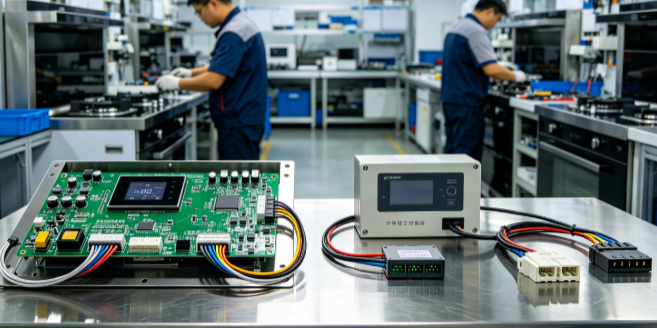
The short answer is that integrated control systems consolidate multiple appliance functions – smoke guide, stove, steam box, oven, disinfection cabinet – onto a single main control board. Standalone controllers, by contrast, use separate control boards for each function – one for the oven, one for the cooktop, one for the range hood.
The difference isn't just technical. It's strategic. And understanding that difference is what separates a sourcing strategy that works from one that creates problems for years to come.
I want to walk you through the practical realities of both approaches. Not a theoretical debate – a genuine, hands-on discussion of what each architecture means for your procurement team, your assembly line, and your bottom line.
2. Understanding the Two Architectures
Let's define our terms clearly, because I've seen confusion around this cause real problems.
Integrated Stove Control Systems
An integrated stove control system is a single control board – or a tightly coupled set of boards – that manages multiple appliance functions. Think of it as the central nervous system of the appliance.
The main control chip, whether 8-bit or 32-bit, satisfies the needs of high, mid, and low-end products. The system integrates the controls of the smoke guide, stove, steam box, oven, and disinfecting cabinet in a modular, flexibly combinable configuration with smart connection capabilities.
Some integrated controllers, like those used in DC inverter integrated stoves, employ FOC-based sinusoidal drive for BLDC motors, support timed turn-off, and provide reserved linkage interfaces for free combination with steam-oven, steamer, or oven controllers.
The key characteristic is consolidation. One board, multiple functions.
Standalone Appliance Controllers
Standalone controllers, by contrast, are discrete control units each responsible for a single function. The oven has its own controller. The cooktop has its own. The range hood has its own.
The IndexBox oven controller market report, for example, defines standalone controllers as separate from integrated control modules. These are distinct products that you source, inventory, and assemble independently.
The key characteristic is separation. Multiple boards, multiple functions.
The Market Context
The global market for appliance controllers is substantial. In 2025, global revenue for home appliance smart controllers was approximately $8.9 billion, with projections reaching $12.6 billion by 2032 at a CAGR of 5.1%. Within this, the kitchen appliance controller sub-segment is expected to grow at the fastest rate, driven by innovations in smart kitchens and IoT integration.
This growth is happening against the backdrop of a fundamental shift: appliance controls are changing from purely mechanical to fully electronic as microcontrollers are incorporated into designs. The question isn't whether to use electronic controls – it's how to architect them.
3. Sourcing: One Supplier vs. Multiple Vendors
This is where the efficiency difference really starts to show.
Integrated Systems: Single-Source Simplicity
When you're sourcing an integrated control system, you're dealing with one supplier for the core control function. One purchase order. One quality audit. One set of specifications. One relationship to manage.
Some manufacturers position themselves specifically as single-source integrated solution providers. They handle design, engineering, and manufacturing of embedded controls for kitchen appliances. This consolidation reduces the complexity of your supplier base.
The benefits are real:
Fewer suppliers to qualify – one technical assessment instead of three or four
Simpler negotiation – one contract instead of multiple
Easier compliance management – one set of agency approvals (UL/ETL, FCC/CE, RoHS) to track
Reduced administrative overhead – one supplier to manage instead of many
Standalone Controllers: Multi-Vendor Flexibility
Sourcing standalone controllers is a different game. You're typically dealing with multiple suppliers – one for the oven controller, one for the cooktop controller, one for the range hood controller.
The IndexBox market report breaks the oven controller market into standalone controllers, integrated control modules, and associated subsystems. These are distinct product categories with different supplier bases.
The advantages of multi-vendor sourcing:
Supplier redundancy – if one supplier has issues, others can fill the gap
Competitive pricing – you can play suppliers against each other
Specialization – each supplier focuses on what they do best
Easier replacement – if one controller fails, you replace just that one
But there are trade-offs. More suppliers mean more complexity. More contracts. More audits. More relationships to maintain.
The Sourcing Efficiency Calculation
Here's what the math looks like in practice:
Sourcing Factor | Integrated System | Standalone Controllers |
Number of suppliers | 1-2 | 3-5 |
Purchase orders | 1 | 3-5 |
Supplier audits | 1 | 3-5 |
Contract negotiations | 1 | 3-5 |
Compliance tracking | 1 set | Multiple sets |
Administrative overhead | Lower | Higher |
Based on industry sourcing patterns
The efficiency advantage of integrated systems in sourcing is clear: fewer touchpoints, less administrative burden, simpler management.
4. Assembly Efficiency: Wiring, Labor, and Throughput
This is where the differences get really interesting – and where integrated systems often pull ahead.
The Wiring Problem
Traditional appliances were monolithic in design, relying on centralized control boards, mechanical interfaces, and hard-wired functionality. This model creates significant assembly complexity.
When you have multiple standalone controllers, you need point-to-point wiring between each controller and its associated components. Each connection is a potential failure point. Each wire adds labor time. Each harness increases assembly complexity.
One industry solution provider describes the problem clearly: manual point-to-point wiring increases production complexity. By integrating all control elements on one relay board, OEMs can cut labor and assembly costs significantly.
The Labor Difference
The labor savings from integration are substantial. Reduced manufacturing costs by eliminating point-to-point wiring is one of the primary benefits cited by manufacturers who adopt integrated control platforms.
What does this mean in practice?
Faster assembly – fewer wires to route, fewer connections to make
Fewer errors – less opportunity for mis-wiring
Lower training requirements – simpler assembly process
Higher throughput – more units per line per shift
One configurable control platform, for example, is designed to reduce labor and complexity during appliance assembly. Standardized models simplify inventory management and speed production timelines, enabling faster time-to-market and higher manufacturing throughput.
The Throughput Impact
The assembly efficiency gains from integration translate directly to throughput:
Fewer assembly stations – consolidation reduces the number of steps in the line
Shorter cycle times – less wiring means faster assembly per unit
Higher line utilization – more units through the same footprint
Lower labor demand – minimal to moderate vs. moderate to high for standalone approaches
The SIB-2020 Smart Interface Board, for example, integrates 20 analog/digital inputs and 20 outputs on a single board, eliminating complex point-to-point wiring while reducing manufacturing and service costs.
The SKU Reduction Benefit
This is a hidden efficiency gain that I don't think gets enough attention.
With standalone controllers, you might have different control boards for different appliance configurations – one for the oven-only version, another for the oven-plus-cooktop version, another for the full integrated model. Each variation creates a new SKU.
With an integrated system, you can use one controller solution across multiple equipment lines. The controller adapts across appliances, reducing SKUs, assembly drawings, and training needs.
The SKU reduction is significant:
Lower inventory costs – fewer parts to stock
Simpler logistics – fewer SKUs to manage
Less engineering overhead – fewer drawings to maintain
Faster changeovers – switching between models is easier
5. Cost Structure: BOM, Inventory, and Total Cost of Ownership
Let's talk about money, because that's what ultimately drives these decisions.
Bill of Materials
The BOM for an integrated system typically has fewer components. One board instead of multiple. Fewer connectors. Less wiring. Fewer enclosures.
This consolidation has a direct impact on BOM cost. As one patent notes, by integrating the control circuit onto a single circuit board and sharing components like the fan circuit, manufacturers save on design costs and can make the product more compact.
With fewer boards and fewer fan circuits, the overall size shrinks and operating noise lowers. The cost savings flow through the entire BOM.
Component Cost vs. Assembly Cost
Here's a trade-off that I see all the time. Integrated systems often have higher component costs – the single board needs to be more capable, with more processing power and more I/O. But they have lower assembly costs – less wiring, fewer connections, faster assembly.
The question is which effect dominates. In many cases, the assembly savings outweigh the component cost premium.
One control platform, for example, is designed to reduce development costs through a pre-engineered, customizable platform that reduces wiring, design, and inventory complexity. Another platform reduces BOM and warranty costs through design-for-manufacturing and supply-chain strategy.
Total Cost of Ownership
The TCO picture is where integrated systems often shine – but not always.
Cost Factor | Integrated System | Standalone Controllers |
Component cost | Higher | Lower |
Assembly labor | Lower | Higher |
Inventory cost | Lower (fewer SKUs) | Higher (more SKUs) |
Service cost | Mixed | Mixed |
Replacement cost | Higher (replace whole board) | Lower (replace individual controller) |
Based on industry cost analysis
The service and replacement dimension is worth special attention. With an integrated system, if one function fails, you may need to replace the entire board. With standalone controllers, you replace only the failed module. This is a real advantage for standalone approaches in serviceability.
The 30% TCO Comparison
In a related field – building automation controllers – a decoupled (standalone-like) architecture can cut total cost of ownership by 30-50% compared to integrated units, primarily by allowing replacement of only failed components. This same principle applies in appliance controls.
However, the appliance context is different. The labor savings from integrated assembly often offset the higher replacement costs. The right answer depends on your specific production volume, service model, and warranty strategy.
6. Supply Chain Resilience: Risk and Flexibility
Supply chain resilience has become a critical consideration in recent years. Let's look at how the two architectures compare.
Integrated Systems: Concentration Risk
With an integrated system, you're dependent on one supplier for the core control function. If that supplier has issues – quality problems, capacity constraints, financial trouble – your entire production line is at risk.
This is the classic single point of failure problem. The integrated VMA (VAV Modular Assembly) units from major brands, for example, combine the DDC, sensor, and actuator into one housing – convenient, but it creates hardware lock-in.
Standalone Controllers: Distributed Resilience
Standalone controllers distribute your supply chain risk. If one supplier has issues, you can potentially find alternatives for that specific controller without redesigning the entire system.
This flexibility is valuable. Some suppliers, for example, offer flexible supply chain options that provide resilience against disruptions, ensuring uninterrupted access to essential materials and components. But with standalone controllers, this flexibility applies to each individual component.
The Sourcing Trade-Off
Here's the reality: integrated systems offer simpler sourcing but higher concentration risk. Standalone controllers offer more complex sourcing but lower concentration risk.
The choice depends on your risk tolerance and your supplier relationships. If you have a strong, trusted partner for integrated systems, the concentration risk may be acceptable. If you're in a volatile market or have had supplier issues in the past, the distributed approach may be safer.
7. Head-to-Head: A Complete Comparison
Let me give you a comprehensive side-by-side comparison.
Factor | Integrated Stove Control System | Standalone Appliance Controllers |
Sourcing complexity | Low – one primary supplier | High – multiple suppliers |
Supplier count | 1-2 | 3-5 |
Assembly labor | Lower – less wiring | Higher – point-to-point wiring |
Assembly throughput | Higher – faster cycle times | Lower – more assembly steps |
BOM component count | Lower – one board | Higher – multiple boards |
Component cost | Higher – more capable board | Lower – specialized boards |
Inventory SKUs | Fewer | More |
Serviceability | Replace whole board | Replace individual module |
Supply chain risk | Higher – single point of failure | Lower – distributed |
Design flexibility | Lower – one board for all | Higher – mix and match |
Time to market | Faster – pre-engineered platform | Slower – multiple designs |
Agency approvals | One set | Multiple sets |
Based on industry data and supplier documentation
Here's what this tells you in plain English:
Integrated systems win on sourcing simplicity, assembly efficiency, inventory management, and time to market. They're the choice when you value operational efficiency and have a trusted supplier partner.
Standalone controllers win on serviceability, supply chain resilience, and design flexibility. They're the choice when you value modularity and risk distribution.
8. Real-World Impact: What the Data Shows
Let me share some specific performance data that illustrates these differences.
Assembly Labor Savings
One integrated control platform is designed to reduce manufacturing costs by eliminating point-to-point wiring. The platform integrates all control elements on one relay board, cutting OEM labor and assembly costs.
Another configurable platform can reduce labor and complexity during appliance assembly, enabling faster time-to-market and higher manufacturing throughput.
The labor savings are significant enough that multiple suppliers now position integrated platforms as their primary value proposition.
SKU Reduction
The SKU reduction from integration is substantial. One controller solution adapts across appliances, reducing SKUs, assembly drawings, and training needs. This simplification flows through the entire organization – procurement, inventory, assembly, service.
Component Consolidation
Integration allows for component sharing that standalone approaches can't achieve. By integrating the control circuit of a multi-burner induction cooker onto a single circuit board and sharing the fan circuit, manufacturers save on design costs, make the product more compact, and lower operating noise.
The Supply Chain Reality
The practical reality is that many leading appliance manufacturers are moving toward integrated solutions. Companies like Ningbo Shunyun Electronics supply intelligent control systems for range hoods, integrated stoves, dishwashers, microwave ovens, steam ovens, and ovens to major brands including Fotile, Marssenger, and Entive.
This trend toward integration reflects the efficiency advantages that integrated systems deliver.
9. Practical Decision Framework for Procurement Teams
Alright, let's get practical. You're making this decision right now. Here's how to approach it.
Step 1: Assess Your Production Volume
High volume favors integrated systems. The assembly labor savings compound across thousands of units. The SKU reduction simplifies logistics at scale.
Low volume may favor standalone controllers. The higher component cost of integrated systems is harder to absorb, and the assembly labor savings are less significant.
Step 2: Evaluate Your Supplier Relationships
Strong supplier relationships favor integrated systems. If you have a trusted partner who can deliver reliable integrated solutions, the concentration risk is manageable.
Limited supplier relationships may favor standalone controllers. Distributing your risk across multiple suppliers provides a safety net.
Step 3: Consider Your Service Model
If you do in-house service – standalone controllers may be more cost-effective, as you can replace individual failed modules.
If warranty costs are a concern – integrated systems may be better, as the reliability improvements from consolidation reduce warranty claims.
Step 4: Think About Product Variety
If you have many product configurations – integrated systems reduce SKU proliferation. One control platform can serve multiple models.
If you have few configurations – the SKU advantage of integration is less significant.
Step 5: Factor in Time to Market
If speed matters – integrated systems offer faster development. Pre-engineered, configurable platforms dramatically reduce development cycles.
If you have long development cycles – the time advantage of integration may be less critical.
The Bottom Line
Here's a rough rule of thumb I use:
Choose integrated systems if: you have high volume, strong supplier relationships, many product configurations, and speed to market matters
Choose standalone controllers if: you have low volume, limited supplier relationships, few configurations, and serviceability is a priority
And if you're in the middle – well, that's where hybrid approaches come in. Some manufacturers use integrated systems for core functions and standalone controllers for optional features. The key is understanding the trade-offs and making an intentional choice.
10. Frequently Asked Questions
Q: What's the difference between an integrated stove control system and standalone controllers?
An integrated system consolidates multiple appliance functions – smoke guide, stove, steam box, oven – onto a single main control board. Standalone controllers use separate boards for each function.
Q: Which is more cost-effective?
It depends. Integrated systems have higher component costs but lower assembly costs. Standalone controllers have lower component costs but higher assembly costs. The total cost depends on your volume and labor rates.
Q: Which is easier to source?
Integrated systems are generally easier to source – one supplier, one purchase order, one set of specifications. Standalone controllers require managing multiple suppliers.
Q: Which is more reliable?
Integrated systems can be more reliable because there are fewer connections and potential failure points. However, if the integrated board fails, the entire appliance is affected.
Q: Which is easier to service?
Standalone controllers are easier to service – you replace only the failed module. Integrated systems require replacing the entire board.
Q: What's the minimum order quantity for integrated control systems?
MOQs vary by supplier and specification. Some integrated control platforms are available in relatively small quantities for development purposes, but production quantities typically require larger orders.
Q: Are integrated systems more expensive upfront?
Typically, yes. The component cost of an integrated board is higher than any individual standalone controller. But the total BOM cost may be lower when you account for wiring, connectors, and enclosures.
11. Final Thoughts
Let me leave you with this.
The choice between integrated stove control systems and standalone appliance controllers isn't about which is "better." It's about which is right for your specific situation – your volume, your supplier relationships, your service model, your product variety.
Integrated systems deliver real efficiency advantages in sourcing and assembly. Fewer suppliers, fewer SKUs, less wiring, faster assembly, higher throughput. For high-volume manufacturers with strong supplier relationships, the case for integration is compelling.
Standalone controllers offer real advantages in serviceability and supply chain resilience. If one controller fails, you replace just that one. If one supplier has issues, you can find alternatives. For manufacturers with lower volumes or limited supplier relationships, standalone controllers may be the safer choice.
The trend in the industry is clearly toward integration. Major appliance manufacturers are moving toward integrated control solutions. Configurable platforms are reducing development cycles. The efficiency advantages of integration are driving this shift.
But here's the thing – and I want to be really clear about this – integration isn't always the answer. If your service model depends on modular replacement, standalone controllers may save you money in the long run. If you're in a volatile supply market, distributed sourcing may be safer.
The key is understanding the trade-offs and making an intentional choice based on your specific situation.
If you're making this decision right now, here's my advice:
Map your cost structure. Understand the trade-off between component cost and assembly labor. Calculate the total cost for your volume.
Assess your supplier relationships. Do you have a trusted partner who can deliver integrated solutions reliably? Or do you need the safety net of multiple suppliers?
Think about the full lifecycle. Sourcing and assembly are just the beginning. Consider service, warranty, and replacement costs.
And if you're still unsure – start with a pilot. Test an integrated solution on one product line. Compare the results with your existing standalone approach. Let the data guide your decision.
The key is knowing the difference – and choosing accordingly.